What Is An Encounter?
You’ve got your players introductions completed and they are now a party. What will they do now? For this I will give an example partial scenario. The players arrive in town and hear shouts that Goblins are raiding someone’s home. The players rush in or sneak in and everyone will roll for initiative. I will cover this for the Goblins soon.
Who Has The Map?
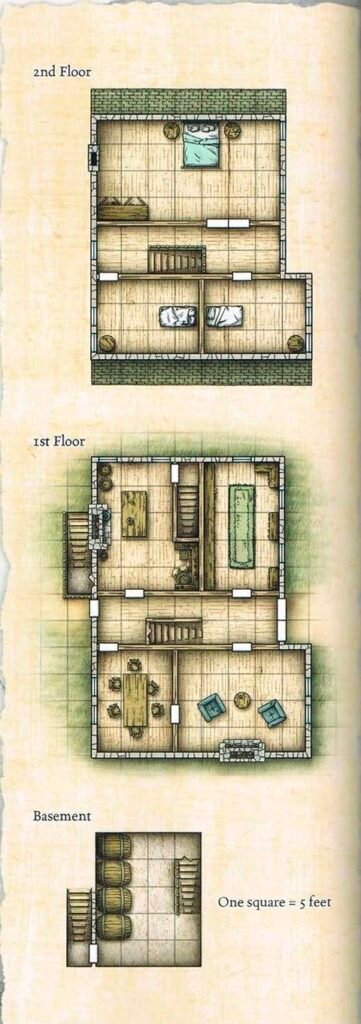
This is a very basic house found in the DMG book. This is a very modest house with 2 entrances on the first floor. The white squares are doors. As this map shows, 1 square is 5 square feet. That means every square takes 5 feet of a creature’s movement. A human has 30 feet of movement speed which means they can move up to 6 squares in 1 turn. Be mindful some maps have a different scale and that affects combat, pay close attention to that scale.
We have this map but it’s empty. With this example, let’s say there are 4 players so there will be 4 goblins and 1 goblin boss. One Goblin per player and one boss to direct them.
After that prepwork is done, describe the scene the players encounter. “Your group runs up to this abandoned house. It appears to be a simple farm house with stone walls. You notice the building is two stories tall and upon further inspection you can hear the sounds of furniture being moved and the sound of breaking dishes. Roll for initiative.”
Depending on if you play in person or online will affect the next steps.
In Person Play:
First off you need a physical map. You could print off the map, making sure that each square scales out to be 1 inch by 1 inch as this is the standard size for D&D miniatures. The second option are special map mats that have a grid already and you draw out the map. Each 1 inch square represents 5 feet. These maps are reusable with use of dry erase markers, be sure NEVER use a sharpie!
If these are not available, you could always buy grid paper and draw out the map, the hard part is having some indicator for players or enemies.
That brings me to the next part. Miniatures or tokens. If you have miniatures you can now place the Goblins around the map. If you don’t have miniatures you can use Lego, coins, squares of paper. Your imagination is the limit as long as you have a way to tell things apart. Place the 4 Goblins and Goblin boss in different rooms.
Virtual TableTop Play:
As there are a wide variety of other virtual tabletop setups, which I can’t go into, because each one is different. The important thing here is, the map files and then tokens of the enemies and players. You can find many tokens online with a quick internet search. If you find an image that isn’t a token you can do so free using a website called Token stamp 2. You drop in the image, set up a border and colors, then download the final product. Familiarize yourself with your tabletop system before the game as some offer advanced fog of war options to surprise players with.
Where’s The Enemies?
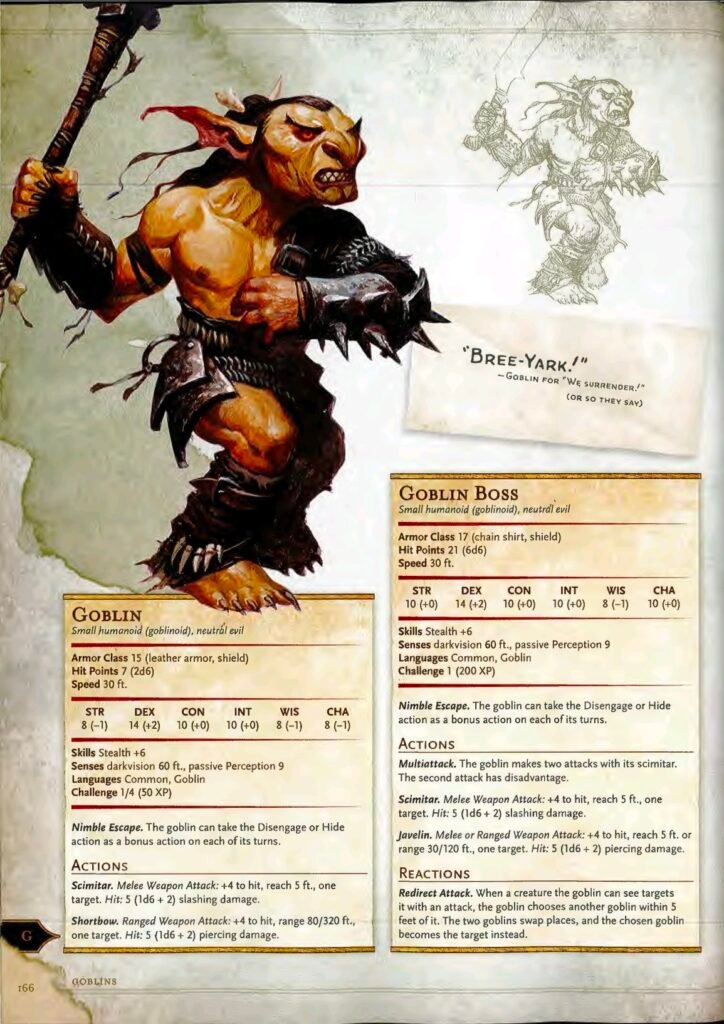
Page 166 of the 5E Monster Manual contains the most basic D&D enemy, the goblin. There’s a few things to take note of. First, each goblin has different HP. You can roll each individual amount if you want or go with the first number listed, which is the average of the dice listed. Either is fine. For this example we will go with the average hp. Mark down each HP separately, per goblin. You can label each goblin as Goblin 1, Goblin 2, and so on. Just be sure to keep track of what mini or token represents each creature.
Next, take note of the dex modifier which is (+2). This is used to figure out a monster’s initiative. Roll a d20 and add 2 to the roll. Do this for each goblin, putting this number before each goblin. This is their initiative order. The highest initiative goes first, generally counting down from 25 one step at a time. Let’s say for this encounter, the goblin boss got 15, the players got between 14 to 10 and the regular Goblins got 8 and under.
What The Goblin Doin’?
For this encounter, we will say the leader hears the players running up. The Goblin has 15 initiative orders and moves first. He shouts out in Goblin, orders and uses his movement to go to the door the players are behind. He opens the door and attacks the player in the doorway.
Looking at the Goblin boss attacks, we can see he has multi-attack with the scimitar. You roll a d20 and add the +4 to hit. This is a melee attack so the Goblin must be right next to the target. If the result is higher or equal to the player’s AC, the attack hits. Roll 1D6+2 and see how much damage the player takes on a hit. Then, roll 2d20 for the second attack because it’s at disadvantage, taking the lower of the 2 d20s.
Finally, if the goblin boss has movement left, he will disengage with a bonus action and move towards cover. The goblin’s turn is now over.
Combat Phases:
Each player or creature has a certain number of actions they can do per turn. These are, Action, Bonus Action, Move, and Reaction. The first 3 can happen in any order, normally Movement is first to get to a target. Reactions are special and trigger based on another creature. Each creature gets only 1 reaction per combat round.
Action: This part of combat can be to attack with a weapon, shoot a bow, cast a spell or use an object.
Bonus Action: These are special actions that are considered faster than an action. Some spells can be cast as a bonus action or have an effect that happens as a bonus action. Some players’ Feats use this, like the Goblin Boss’ Nimble Escape.
Movement: The creature moves as many feet. This can be split up between actions. But be warned, if you move next to an enemy then away without Disengagement, they get an attack of opportunity, which is a single free melee attack against you.
There are a couple of other things that can be done but take a full Action. Examples are, Dash, Dodge, Disengage, hide, Help. I wont go over them all but Dash allows you to move double your movement speed.
Additional Notes On Combat:
A single round of combat ends on the lowest initiative account, then you go back to the highest. This is a single round takes 6 seconds in game time. 10 rounds of combat is 1 minute of in-game time, this is important because some spells take more than 1 minute to cast and are generally not usable in combat. Most combats tend to only last 3 to 4 rounds.
Conclusion:
Combat takes a lot of time and preparation. It can slow down the pace of the game especially if you don’t have maps or notes ready on possible creatures or obstacles. I hope this brief article gives you a basic understanding of combat because at the end of the day, combat can become very involved and could take up a whole session, and I can’t cover every edge case in a single article. As always, leave feedback if there is something you want me to specifically cover.

I’m a published author that has written various stories over the span of about 25 years. I’ve also been playing TTRPGs for just as long, if not longer. I am currently DMing a campaign thats been going for about 5 years and still going.