What Is A Difficulty Check(DC)?
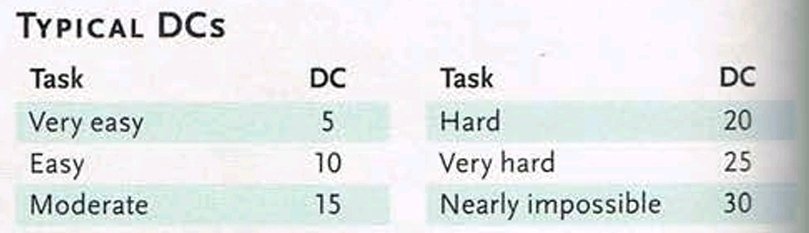
(Image from the 5E DMG, page 238)
One of the most common acronyms in D&D you will hear a lot is DC. DC stands for Difficulty Check, which is a universal mechanic that states how hard it is to complete a check. Yet, that can be misleading to new GM/DMs. This table is a good starting point to have an idea but, the numbers must be scaled depending on a players level. At level 1 a player will never be able to pull off a DC 30, and as thus most DCs will average 10 or 15.
Anything requiring a D20 roll generally has a DC tied to it, be it a skill check, saving roll or even an ability check. The table here goes up by 5 so it’s easy to remember the range of numbers. A thing to note is if a player tries to repeat the same action like a skill check, the DC will rise, becoming more difficult until you reach the maximum of 30. A DC can never be higher than a 30 according to the rules as written.
You also don’t need to announce these numbers to your players if you want to have a surprise. Some DMs will outright say how much a DC is so the players know the rulings are fair.
Different Ways To Handle DCs
The standard way is to think of the number before having a player roll. An example is the player must search a messy room for clues as to who robbed this place. Since the room has been trashed, this would make it difficult to search and time consuming. You would assign the number to be 20 using the investigation skill. You could say, “The room has been tossed and it’s going to be hard to investigate for clues.”
This can lead to very binary outcomes and it is recommended to never put critical story progression behind a single DC. If the next part of the story happens behind a locked door and the players can’t get past the lock, the story immediately grinds to a stop. So always have multiple ways a player can progress through key points, like a guard having the key if the Rogue fails to pick the lock.
This is where the concept of a sliding difficulty comes in. Instead of using the DC as a hard cap, you use it as a starting point. You still set the success number, but not meeting that number doesn’t mean an instant failure. Here the players must ask around looking for information. In this example the players must roll an investigation, DC 15. If the player rolls a 12, that’s an almost success. The quality of information is lower but they learn enough key facts to continue, minus the one thing the NPC held back from explaining. This way even a failure still allows progression.
Concluding The Difficulty Chat
DCs make D&D go round. Most other TTRPGs use a similar kind of system based on thier own rules. This article is meant to deal with D&D rules for DC, but the approach can work universally for other gaming systems. Remember to never lock your players out of critical story progression, but also don’t use this to hardworking a player out of an action unless it’s something that detracts from the game.
As always, leave a comment on this post with questions or topic ideas. You can always join WallyDM’s discord to discuss topics as well.

I’m a published author that has written various stories over the span of about 25 years. I’ve also been playing TTRPGs for just as long, if not longer. I am currently DMing a campaign thats been going for about 5 years and still going.




One response to “How To Deal With Difficulty Checks.”
I really appreciate your articles. Very helpful for a new DM, but also a pleasant refresher for experienced DMs as well.
Your point about story progression cant be stressed enough. It is so important to ensure progress doesnt stop on failed attempts.
I’ve been stuck there before and it is anuncomfortable hole to climb out of.
Also, I dont know why, but I default to DC 12 or DC 15 almost all the time. Sorta easy and average for those proficient.
Keep up the great work. Cheers!