As a budding DM, have you thought “official published material or my own stories (homebrew)”?
This simple decision dictates the overall feel and vibe of a campaign. It is about your long term approach rather than the session itself.
Of course you could just stick with one-shot games, but that is a different skill altogether which we will cover another time.
Official Content
Official Content has benefits. If you have never DM’d before, or the group hasn’t played, then a published story gives you really good guide rails. Well balanced stories and encounters are there ready for you. Disclaimer – this does not count for Ghosts of Saltmarsh which is based on AD&D stories from the 1980’s. Old timers know that AD&D was an altogether tougher experience where death is easily found. I have seen experienced DMs become a cropper trying to run that campaign!
But don’t think that official is necessarily an easy option, or at least any easier than your own homebrew.
First you need to find a story that you can relate to and enjoy. When you are engaged, then your players are engaged. You need to do some research, read up on the various campaigns published to find that sparks your own imagination. People sometimes recommend Lost Mine of Phandelver as a starter but it is (in my opinion) not a good story. I can’t run it because it doesn’t excite me. Whichever book you chose will set your tone, you need to get it right.
Secondly, you need to really do your homework before each session. Those guide rails also mean you don’t have much freedom. You need to read through the chapter multiple times, and study the map to understand it. Often official maps have areas that don’t seem to quite fit the description in the text. Or some descriptions are confusing. You need to be aware of those in order not to trip up.
When I have tried to run official content I have always found it harder than my own homebrew.
Homebrew
Surely this is simple — unleash your imagination and follow it wherever it goes.
Sounds great. But it isn’t quite that easy.
There needs to be continuity. You can’t switch and change every session. The world needs to make sense in order for your players to engage. While the physics of your world may differ from the physics we know, the world must act the same from day 1 to day 365. One of the reasons Terry Pratchetts Discworld series works so well is that despite it being incredibly weird, it is also incredibly consistent from book to book.
And you are going to have to keep track of a lot of things. How do the kings interact with each other, what happens during various seasons, are there wars that may impact the PCs? Which are the key trading cities, which are the rival gangs, is magic allowed?
It’s a lot to manage – but there are programs to help, for instance Scabard and World Anvil both provide great resources in very different ways.
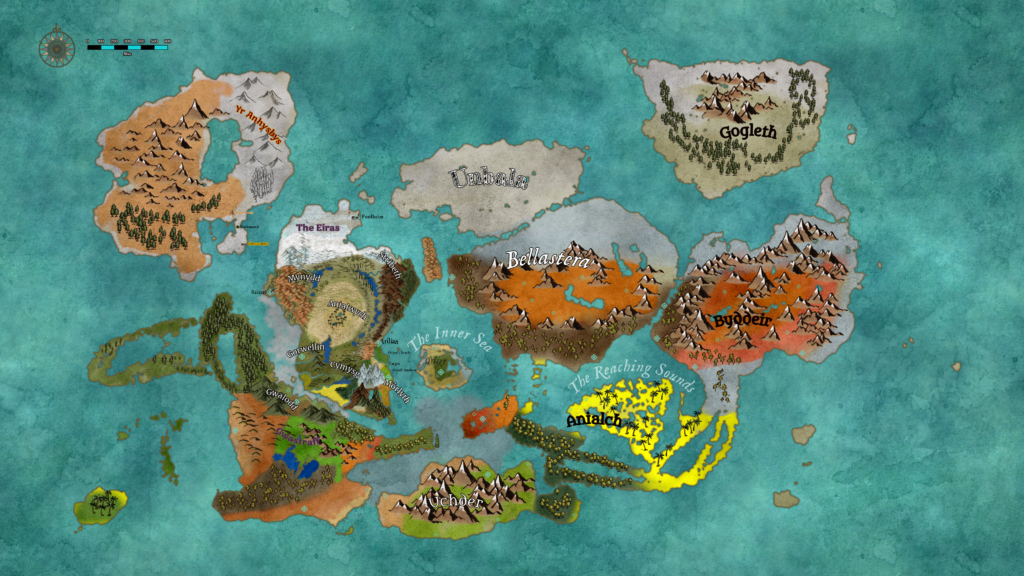
When I came back to RPGs just as COVID hit, I picked up my notes from 30 years ago. I found the world that I had imagined back then. I had kept all the sketches and notes I had made. Taking those, I explored and experimented with the “modern” tools available. From that I created the world and the map above, along with an idea for what I wanted. I had the beginning and the end. The middle depended on the players and their decisions. By the end of the campaign, four years and twenty levels later, it did not end as I imagined, but homebrew was immense fun.
Hybrid
This is a wonderful compromise. There is nothing saying that you have to follow published content page by page. There is nothing saying that you can’t add other peoples material into your own.
Maybe you start with a book but you add your own stories to give added depth. As a perfect example I recommend you listen to my favourite podcast, Dice Shame. Jo is an amazing DM, I keep learning from her (and have been lucky enough to play in some of her games). They have taken Storm King’s Thunder and then used it as a scaffold to build an amazing story. The main story is following the official content. But Jo is not afraid to tug on a thread and suddenly the group are off on a side quest. It is seamless, you can’t tell what is published and what is Jo.
Or maybe go the way I have in my current campaign. Build a world, have an overarching story, but pick adventures out of various books to add in, mixing and matching as you want. I just slipped “The Forge of Fury” from “Tales of the Yawning Portal” into my campaign. It gave me a big story that ran through multiple sessions. In addition it sparked new ideas as the players interacted with the dungeon and what they found.
Look Around You
Where do ideas come from? Look around you. Things around us constantly invite adaptation.
How about your favourite song? Listen to the lyrics and maybe you will find your story. I made a quest from the lyrics to “Broadsword” by Jethro Tull. I have used that both in my weekly campaign and also in the Discord server game that I am in. The lyrics gave me the reason for the players to get engaged, introduced the main antagonist, and suggested a couple of side quests to find items.
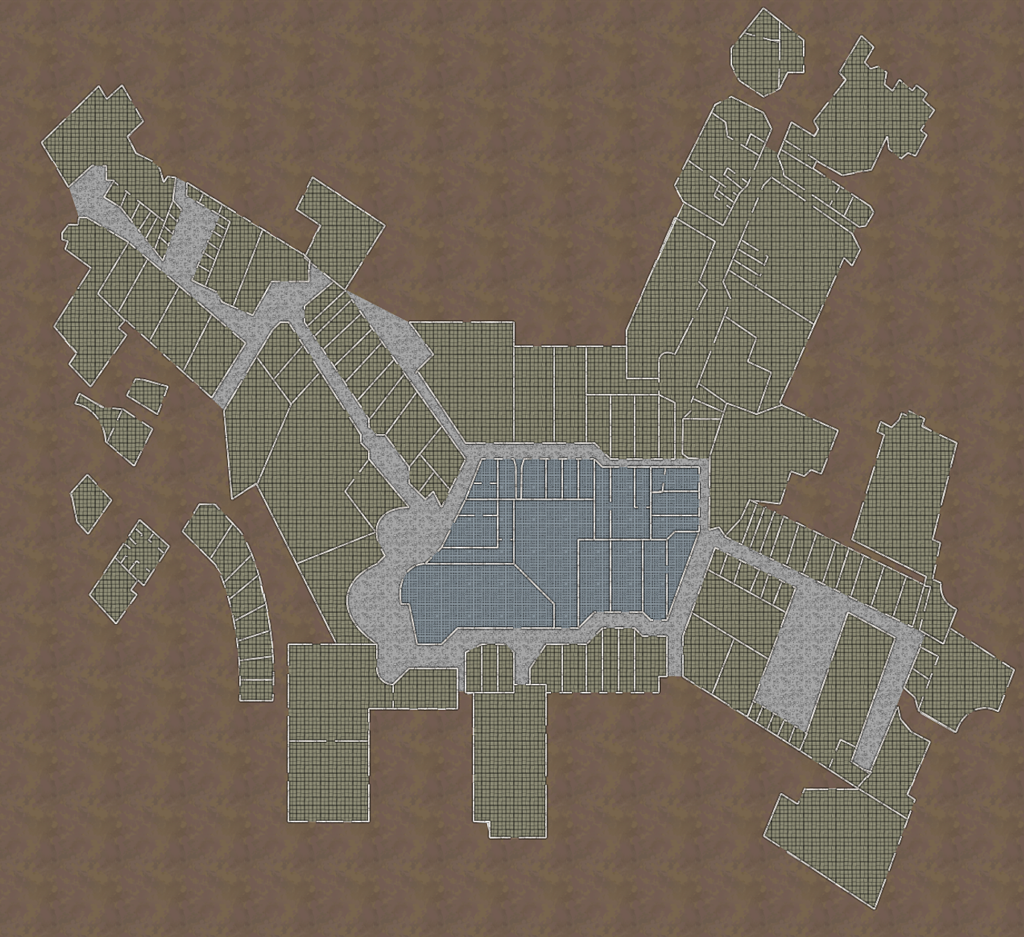
The map to the right (OK, not one I am proud of, that’s not the point, it was in my early days of mapping, I have learnt a lot since then) came about because I wanted a large base for a cult. Rather than start from scratch, I took the blueprint of a shopping mall and used that.
Just Have Fun
This is the real point. It doesn’t matter which you chose. You don’t have to follow a dictated path. One of the amazing things about D&D is that there is no one way to play. It is open for your interpretation.
Whether you go official, or homebrew, or a mixture, talk to other DMs. And talk to your players. You can always adapt as you go along.

Involved with RPGs since the 1980’s (not that I like to think about exactly how long ago that is), mainly focused on being a DM for D&D but also dabbling in other rulesets.
Run long running campaigns, one shots, convention games, and open world servers on Discord.


2 responses to “Home or Away”
This article ties in a bit deeper that my intro to new DMs. There’s so any ways to have an adventure.
I actually used all of witchlight for a singlr arc in a game I’m running. My game is mostly all homebrew beyond that.
This is truly a stellar breakdown and analysis of games to run as the DM.
I like to run published content, but add homebrew built around character backstories. For instance, we had 2 sessions at a character’s family farm outside of Phandalin that helped enrich and reveal their backstory. It was grand!
As a DM, I want to be like Jo. 🙂
Well done Merlin, I really enjoyed the article and… added “cropper” to my vocabulary.