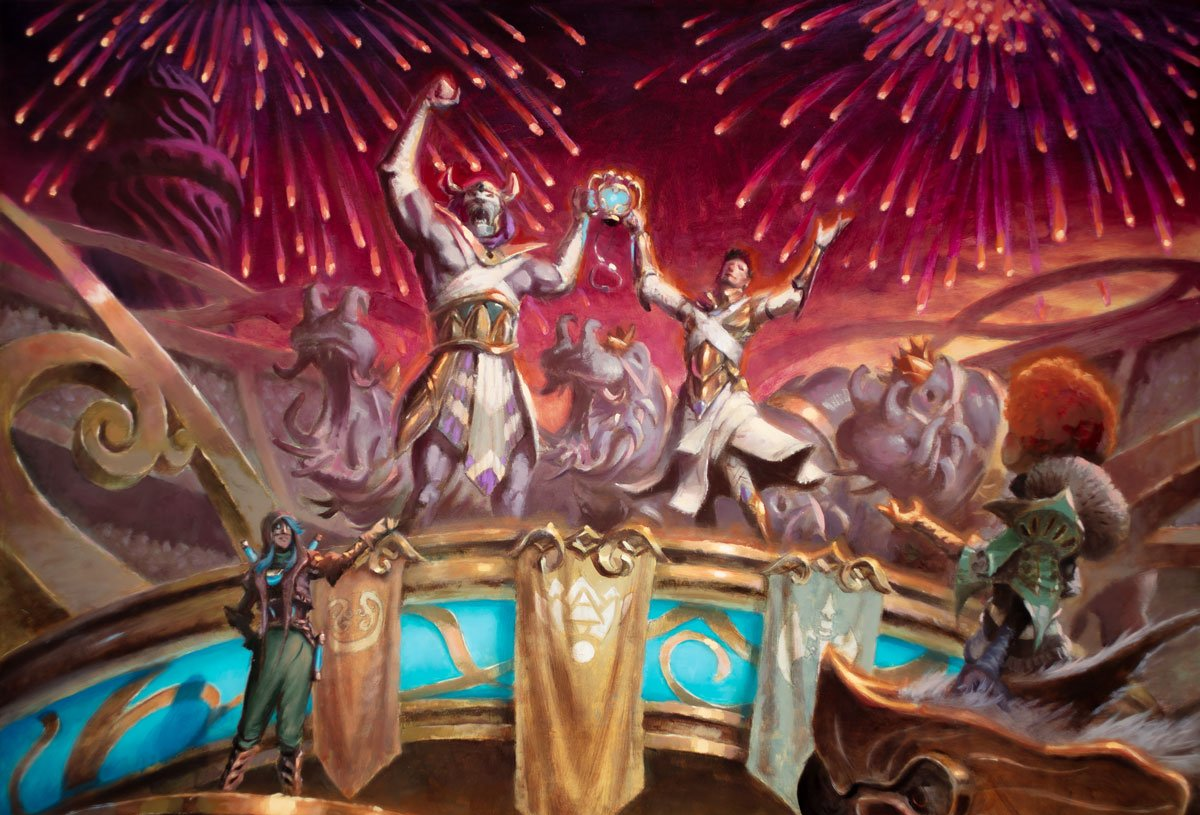
Exhausted but victorious, the heroes stand in the rubble of the Dark Lord’s fortress. The struggle was long and hard, but evil has been defeated. The lands are now free. The rebuilding can begin.
A lot of campaigns end this way. But what about making this the beginning of one?
When the world-level threat is removed, it’s easy to assume the only possible follow-up is an even bigger and more powerful villain. Anything else would be anticlimactic, right? Not so fast! In this short series of articles, I hope to show that an “aftermath” campaign can be just as engaging and full of drama as the initial quest to defeat the Big Bad. This type of campaign presents a unique opportunity for the PCs to shape the society that rises from the ashes. Players can see the results of their characters’ choices in immediate and tangible form.
An aftermath campaign could be a sequel to one in which the player characters (PCs) actually defeat the Dark Lord. Alternatively, that epic battle might serve merely as backstory. The original heroes might now be the questgivers, or they may have given their lives in the fight, leaving the new PCs to take over.
There are several options for structuring an aftermath campaign. Some are more straightforward and action-oriented, while others will rely more on scheming and roleplay.
1. The Clean-Up Campaign
The PCs join a squad tasked with weeding out the last remnants of the Dark Lord’s power. Laying the ghosts to rest on cursed battlefields. Storming the hidden laboratories where dark alchemists still carry out their gruesome experiments and destroying their research. Locating and repatriating stolen treasures and artifacts.
The tone of a clean-up campaign will typically be highly optimistic. Every mission the PCs carry out makes the world just a little bit better, and they will be able to see how their efforts make a difference in the lives of ordinary people. But for a darker spin, the PCs may also have to clean up some unsavory schemes their own side resorted to in desperation during the war. Will they keep quiet or expose those responsible?
This type of campaign is particularly effective at quickly pulling the PCs into the world. Although the threats they face may be limited in scope, they are tied to the previous war, giving them greater resonance than if they were simply caused by a petty evildoer. For example, consider a typical low-level adventure to free a town from bandits in the nearby forest. If those bandits are the last remnants of an occupying army, the story immediately feels weightier because of the memory of destruction carried out by that army. This can also be an excuse for the GM to spice up the bandits’ abilities by giving them more powerful weapons or magic.
Inspirational Media: Pumpkin Scissors, a manga and anime about the adventures of a war relief unit following a magical version of World War I. Sometimes they battle the remnants of their former enemies; sometimes they must fight corruption and red tape among their superiors.
2. The Lieutenant Rallies
The Dark Lord’s top commanders are still at large with armies, resources, and infrastructure at their disposal. One of them may attempt a counter-invasion to reclaim what the Dark Lord lost and become the new supreme leader. The PCs must protect the fragile new order from a threat that would destroy it before it even has a chance to bloom.
This may be the most straightforward type of follow-up campaign, and it comes with some obvious advantages. It gives the players a clear objective and a single antagonist to focus on. But it also comes with pitfalls. It’s important not to make this feel like a retread of the previous battle. And it’s easy to wonder, how could a mere underling ever be as credible or interesting a threat as the original Dark Lord?
You can counter both of these difficulties by giving the lieutenant a distinction and an asset. A distinction means the lieutenant should have a unique personality, philosophy, or leadership style, something that makes the character stand out as an individual. And an asset means giving the lieutenant some key to winning that wasn’t available to the original Big Bad: new allies, a new weapon, a new spell. This ensures that the heroes will have to develop a new strategy to fight this threat.
The other thing that will make this story feel fresh is that now the PCs are the defenders. They will need to rally an exhausted, wartorn country and use its depleted resources to stave off this new attack.
Inspirational Media: Timothy Zahn’s “Heir to the Empire” trilogy of Star Wars novels. Grand Admiral Thrawn is an excellent example of a lieutenant who is very different from his boss and has a large fanbase in his own right.
To Be Continued
The next part of this series will detail more ideas for what to do after the Big Bad is defeated. Meanwhile, have you ever played an “aftermath” campaign? If so, what was the premise? Please share your thoughts in the comments!