Over the past decade, I have written and published over 100 puzzle encounters that game masters can use in their Dungeons & Dragons™ and tabletop role-playing games. You can find my work in several published adventures, the Journal of Puzzle Encounters series, and in the upcoming Game Master’s Book of Puzzles and Wonders. In addition, the Wally DM YouTube channel now hosts nearly 200 videos featuring puzzle and trap ideas. I feel like I am at the halfway point in my content creation career, with plenty of engaging ideas still to build on.
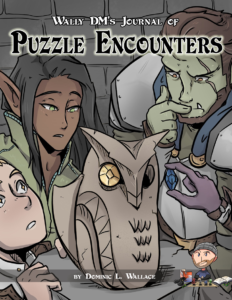
With credentials out of the way, I wanted to discuss one of the questions I get asked from time to time: “how do I create puzzles?” While I do not believe there is a definitive method that must be followed, I would like to share one of the approaches I use when trying to concoct a puzzle encounter: Backward Design Puzzle Creation.
Today’s post frequently references puzzles from the original Journal of Puzzle Encounters. If you do not have that book, you can pick up the PDF of 60 TTRPG puzzles today for only $4.99.
Start with the Primary Solution
Let’s begin with the end. I like to envision what I want the solution of the puzzle to look like, and then work backwards to see how it can be accomplished. What is the primary solution to the encounter I want to build for my players? Most of the puzzles in my original Journal of Puzzle Encounters began as an answer, and I needed to build the question around it. For instance:
- I thought it would be cool to have a puzzle where the players needed to mix colors in order to open doors. One of my most famous puzzles of all time, the gemstone eyes and owl statue in The Prismatic Owl, came about to serve as the question to the color-mixing answer.
- The Magician’s Sword Box began with the idea of players solving a puzzle by putting phases of the moon in order. While the final version included swords and a magical teleportation box, the core of the puzzle is based on the lunar phase images.
- I liked the idea of solving a puzzle with a fork, knife, and spoon. In Fork, Knife, and Spoon, the characters need to search the kitchen for ordinary silverware utensils that unlock a door.
- Another idea involved having the characters open a door by having their hand turned to stone. The Door of the Stone Hand puzzle provides a fountain of blood that turns a character’s hand to stone so it fits into the relief of a hand outline.
- My goal for the Vegetarian Altar was to trick the players into offering a blood sacrifice when a plant sacrifice is the correct answer. The characters can simply smash a pomegranate found nearby rather than killing an innocent squirrel.
- Finally, the Magic Mouth Puzzle came about when I decided to create a puzzle that could only be solved by the characters using their sense of taste. I have some fond memories of this one, where the characters interacted with the magic mouth and needed to place identical cubes in the correct position.
Keep in mind that we are creating the primary or intended solution for our puzzle. During gameplay, it is quite common for players to come up with creative ideas that suffice as an acceptable answer. If the proposed solution makes sense, be sure to reward players for their creativity.
Create the Mechanics
Now that we know the solution, how does the puzzle work? What items or information are needed to solve the puzzle? How do the characters interact with the puzzle? How do they input the answer? This could be done in a number of different ways: dials, levers, rotating statues, orbs, paintings, and mirrors are all common examples. Or perhaps they simply need to verbally give an answer to a golem, spirit, or other being. For example:
- Inserting the eyes into the Eyes of the Obelisk or gemstones into The Prismatic Owl.
- Inserting identical taste cubes into the square holes underneath the murals in the Magic Mouth puzzle.
- Answering the riddle of the golems in The Riser Golems.
Clues
How will the players know what to do? Where do they get the answers? How can they identify items that could be used to solve the puzzle? Providing enough information for a puzzle to be solved without giving it away is one of the trickiest aspects of puzzle creation. Clues are information provided immediately when describing the scene, through trial and error, or by exploration, none of which are hidden behind a dice roll. Clues can also be keys or puzzle pieces, items or information needed to activate or complete a puzzle.
- In Riser Golems, the spinning hands moving clockwise or counterclockwise indicate which direction to travel.
- In Door of the Lucky, the four-leaf clover, horseshoe, and rabbit’s foot are all clues.
- In Eyes of the Obelisk, the players cannot solve the puzzle without the statues and the missing parrot and spool of thread that go with them.
- The term “Shadow Maker” on the light cannon in the Door of Shadows puzzle provides a clue on what to do.
Create the Environment
Now it is time to build the puzzle. Where does this puzzle take place? What does it look like? If additional information is found elsewhere, what do those areas look like?
- The characters enter a two-level atrium with crows swarming about. A control panel on the upper floor sits across from an open, translucent, floating door. On the lower level, an item is visible, but there are too many crows to determine what it is (The Scare Crows Puzzle).
- The base of a stone tower cracks with small leaks that are continually repaired by clockwork gnomes. The characters need to figure out how to reach the top of the tower (Whatever Floats Yer Boat).
- An entity in a mirror interacts with the party, providing information and unlocking doors (Opposite Mirror).
Hints for Additional Insight and Information
Be prepared to give your players hints when needed. What may be obvious to you might not be obvious to them. Hints can be given through ability checks using skills or tools. The most common are Wisdom (Perception) or Intelligence (Investigation) checks, though other skills such as Religion or History may also apply. Successful rolls should grant additional insight the players did not have before: objects that can be moved or rotated, identifying patterns, eliminating conflicting possibilities, or realizing that more information is needed to solve the puzzle.
As a warning, be careful about making puzzles mandatory. If a puzzle is required to proceed and the players are unsure what to do, the entire session can grind to a halt. To prevent frustration, consider allowing abilities, actions, or resources to be used without requiring a die roll to determine success.
Utilizing easy puzzles that can be solved logically or with lateral thinking usually works but always be prepared to offer hints if the players are not able to connect the dots. If you dislike the idea of a puzzle blockading the route forward, consider making them optional, but with a worthwhile reward. Alternatively, both success and failure could allow progress, but failure may trigger consequences such as alerting nearby monsters, destroying fragile treasure (like potions), or activating a trap.
Reward for Solving the Puzzle
Now that we have our puzzle, what happens when the players provide an acceptable answer? Does a door previously sealed by a 60th-level wizard unlock, allowing them to continue to the next part of the dungeon? Does a portal open to teleport them elsewhere? Perhaps a secret compartment is revealed, containing treasure, loot, or an item they were searching for?
Rather than a physical reward, a puzzle might reveal important information, free someone from a curse, or advance the story. What happens when the puzzle is solved? What is its purpose?
What about an incorrect or failed attempt? What happens if they get the answer wrong? Do the characters take damage? Are they cursed? What is the price of failure? Some puzzles may allow for additional attempts. If so, how does the puzzle reset itself? What prevents players from brute-forcing the puzzle or simply trying every possible combination until it is solved?
Always Remember
Puzzles should be easy, memorable, and fun. Some of my favorite puzzles are those where I present the scene and watch the players work together to develop ideas and possible solutions. Like combat, puzzles can provide a challenge with a satisfying sense of accomplishment when solved. They can also create memorable stories that players will tell for years to come.
What are some of the ways that you create successful puzzles? Be sure to leave a comment below!
On to the Next!
—wallydm

Hello there adventurers! Wally DM here. If the topic of this article interests you, please check out the corresponding video for more coverage. I hope to see you on my YouTube channel as a new subscriber! Thank you for reading and on to the next!



4 responses to “Backward Design Puzzle Creation – How to create D&D Puzzles”
I will definitely be using this next time I try to create one. Thanks
Glad you found it useful. And hey, thank you for reading! Cheers, my friend!
I really like how you break down the backwards design method of puzzle creation! As a teacher, this is exactly how I structure my lesson plans, so seeing it applied to TTRPG puzzles makes so much sense.
The concept of the “wrong” genius is also great to remember. The solution the party comes up with might not be what you’re looking for, but if it works, reward them. I’m personally working on leaning into those unexpected player solutions and rewarding them.
Thanks so much for the tips; I’m already using them to tighten up my next puzzle!
This was a great read. Making puzzles as a fun break in action is ideal without breaking progression. Since I am currently running a game for a solo player, I have to be careful with puzzles.