Tables are one of the iconic elements of TTRPG culture.
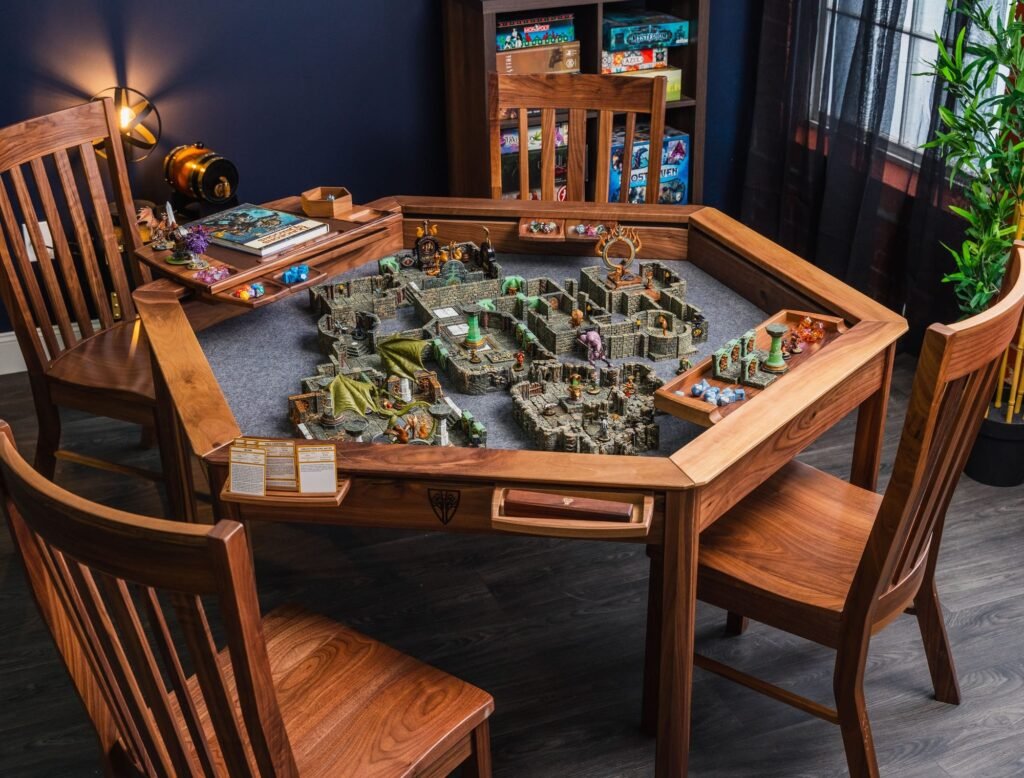
No, not a sponsored post, I’m talking about random tables, sets of items that you roll dice to select from as you play. When Matt Groening needed a bit to represent Gary Gygax on Futurama, his pull was literally just random tables.
But, there is also a lot of pushback on tables. People think that random tables are “lazy DMing” or that they “don’t build good stories” or any number of other complaints. As a huge fan of random tables. I’m here to tell you that, yes, you should be using tables, probably more than you are. Here’s why and how.
25-35 Lather, Rinse, Repeat
The biggest thing tables give you in your game is replayability. You can have a party travelling for a month across the grasslands, and no two days will look the same. You keep mixing events, landmarks, challenges.
Just a few tables add up quickly. If you have a d6 table for weather, a d10 table for landmarks, and a d12 table for events, that’s 720 possibilities for travel days.
Tables also give your game prep the “¿porque no los dos?” option. If you’re preparing the travel session, and you have several ideas for good encounters, you can include all of them as different options on the table.
It also lightens the load, you don’t need to have everything planned out in detail, you can let tables do a lot of the heavy lifting. Like automating a work process, it takes work up front, but it saves time down the road with reuse.
36-60 Proper Table Construction
In terms of statistics, think about how you can structure tables. A table can be a simple list of 20, 36 or 100 items, though it will often help you out to group together ideas. In the case of a d20 encounter table, you can make 5 mysterious encounters, 5 positive encounters, 5 aggressive encounters, and 5 encounters that point to sidequests. It will help you to fill those in much faster.
But you can also have more complex tables by using some simple probability tricks. A 2d6 table puts the most common events at 6, 7, and 8 and the rarest at 2 and 12. That’s a great resource to have, being able to make the weirdest and most dramatic events rarer than more banal happenings.
You can also modify your tables. You can add the party’s reputation score to a table of side quests they will be presented with, so that people will only bring them high level quests once they trust the party, and won’t be asking the king’s royal guard to fight a rabbit.
Relatedly, you can have multiple tables interact. The table for the overall wealth of a town might be added to the result for its primary industry meaning you’re not going to get a poor village composed entirely of bankers, or a rich community of bone pickers. In this case if the economics is a d4 table, the “d20 table” for occupation would run from 2 to 24 instead of 1 to 20.
As an extreme version of this, I LOVE blunderbuss tables. These are moments when you need to determine something complex, like a dungeon or sidequest, a full settlement or a day’s travel. You take a full set of dice, d4, d6, d8, d10, d12 and d20 and throw them at the same time. It lets you get all your information in one go and build in lots of compelling interactions between the dice.
Blunderbuss tables have the added benefit of putting the fear of the Gods into your players when you throw a full set of dice at once.
61-97 Time to Make the Meaning
A final key point about random tables is specificity. I like tables that provide more inspiration than details. The goal is to give you ideas to use when you need to improv a scene. It’s an artform creating table entries that give enough detail to be compelling while still serving as inspiration instead of fixed items.
My exception for this is mechanical elements like creatures and traps. For these, you need to have them point to a specific creature or include things like DCs and damage dice so that you’re not trying to invent those items on the fly.
This use of tables speaks to a central idea of TTRPGs. The entire hobby is an exercise in meaning-making. We take things like die rolls, ability scores, and abstract figures and turn them into compelling stories. This is an incredible thing, weaving moving narratives from the noise of randomly generated numbers.
98-00, wrapping up.
The explosion of solo RPGs speaks to this by putting the whole role of the DM into a series of random tables.
Random tables have tremendous value in an RPG game. They make the process of DMing easier by letting you prepare inspiration before you are put on the spot. You can exploit the times when you have ideas and bank them away for moments you feel lost.
They are a great tool, and if you’re not using them because they’re too chaotic or lazy, try them out, you might be surprised.
My name is Joe Gaylord and, as Lazarus Game Lab, I make bestselling TTRPG content by nerds, for nerds. My adventures and supplements let you play games that are a little cleverer, a little more interesting, and a little different, the kinds of things you want to have for your table.
Check out my work on: https://lablazarus.carrd.co/


3 responses to “01-24 Turn the Tables!”
First off, I dont speak Spanish and you never explained what it means.😅
But yeah, tables are fun to use. I make custom things since a lot of my campaign is homebrew.
Ah, heck yes. Random Tables are the best. I enjoy using them, and creating them. Most are a fantastic tool for improvising a game, but they can also be used to spark ideas when prepping a game, or filling out details of dungeon room contents, treasure, monsters, or what have you.
Heck, if you don’t like rolling on random tables, they also serve another purpose… they are an ordered list. So, the GM can simply look through this table of ideas and choose what they want to be inspired by.
I’ll be including some random tables in the Quintessential Guide to Urban Encounters for Tavern Names, NPCs, and a d100 of urban encounters – I’ll need to be sure to get you a copy.
Another splendid topic. On to the next!
Oh hey, I had to come back and tell you that numbering the subtitles was clever!