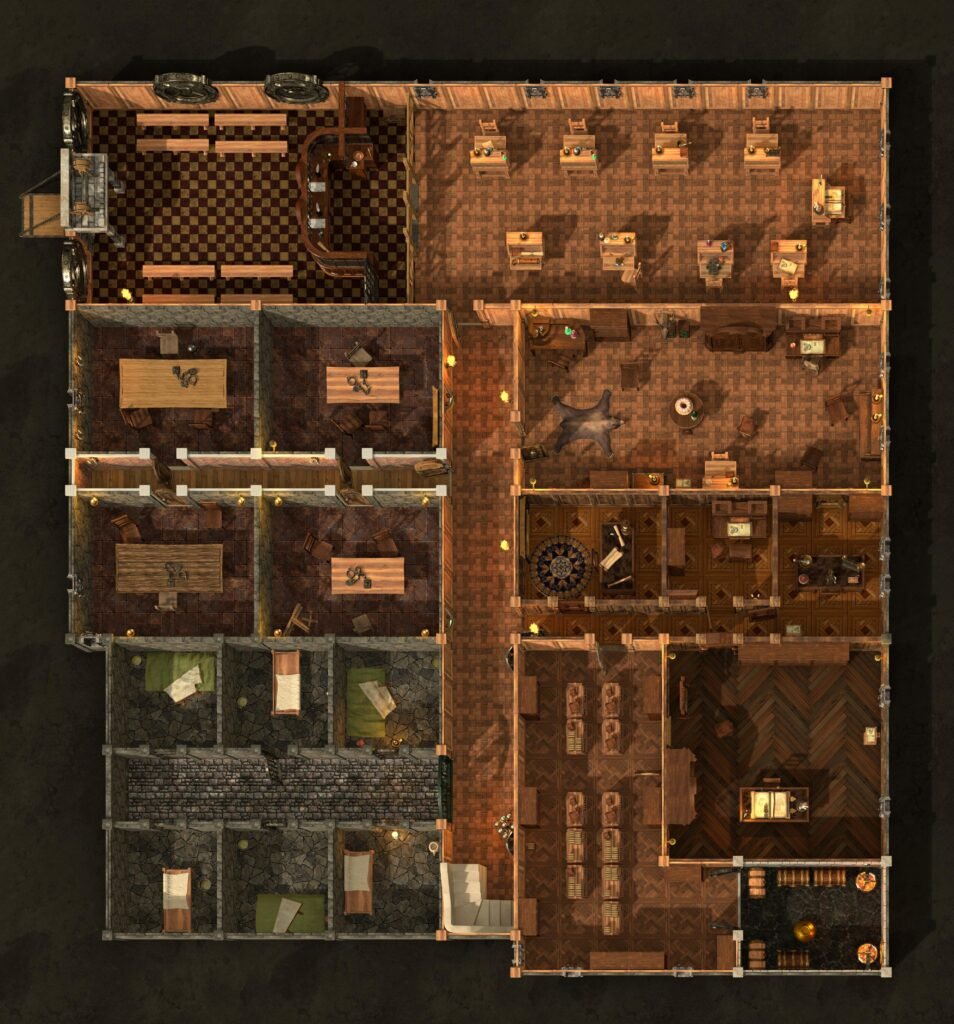
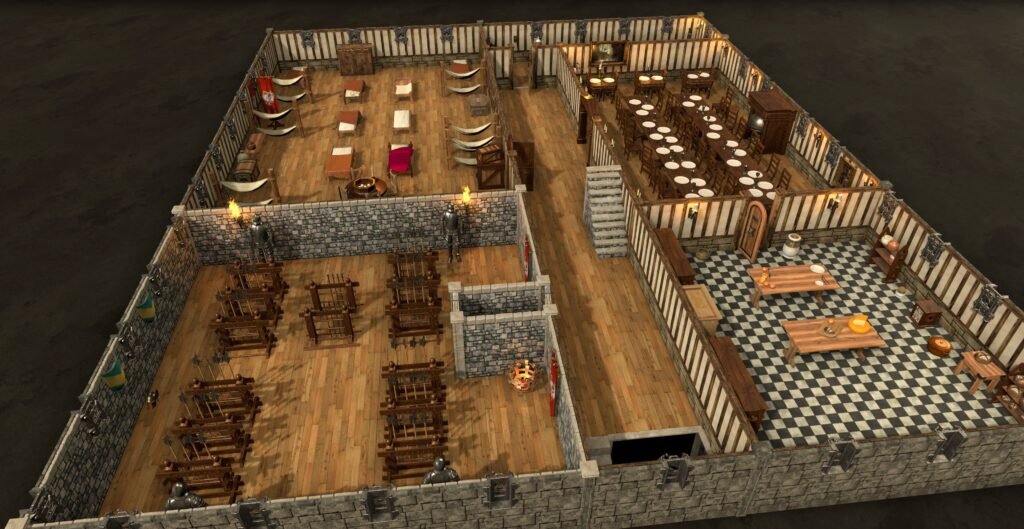
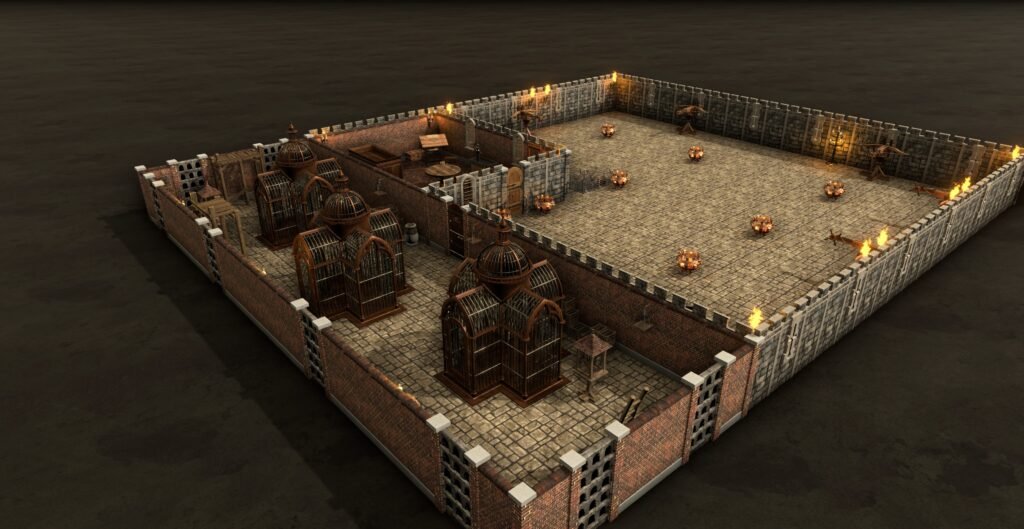
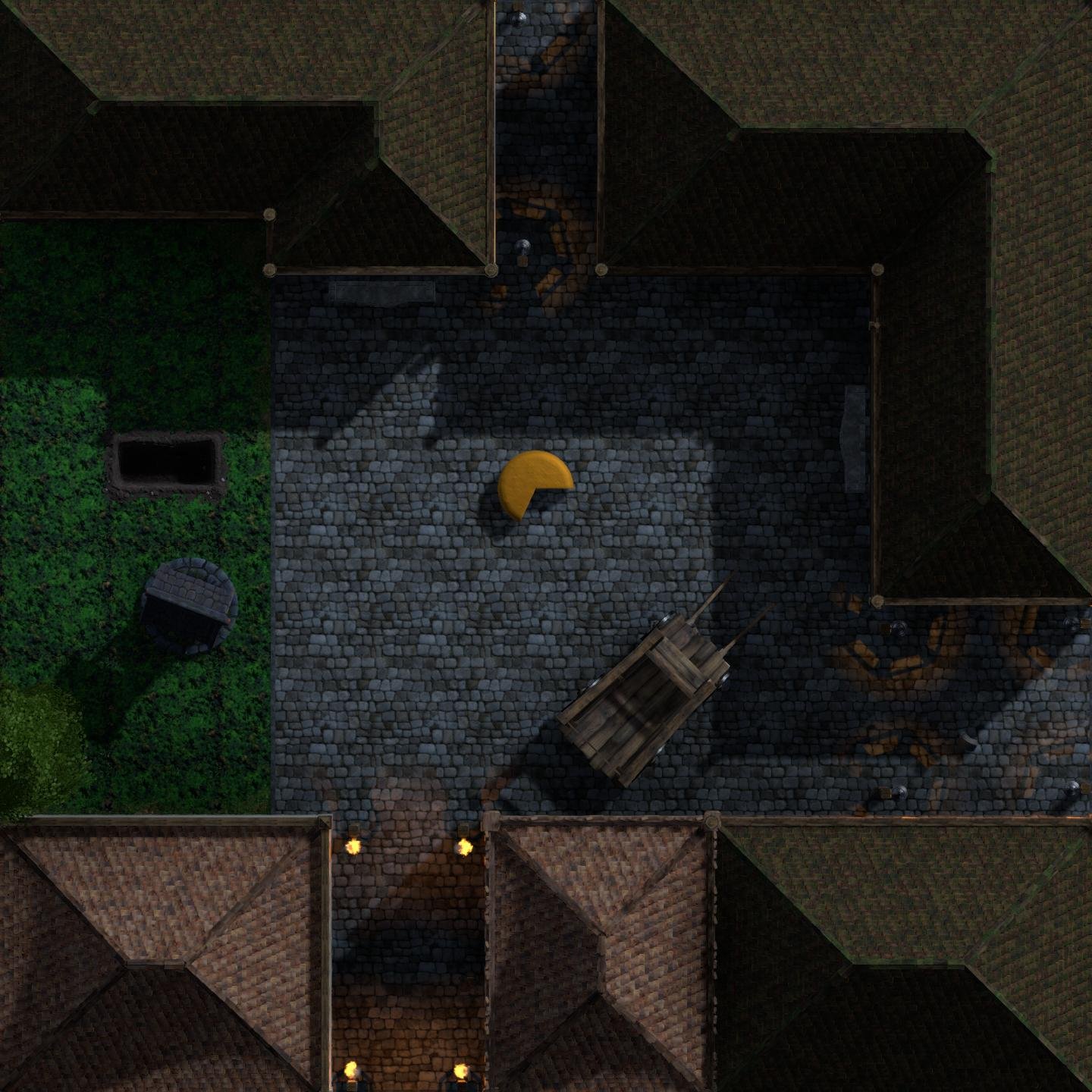
Improvisation (improv) or prepping? There’s a BIG question, and I often hear it asked by those interested in being a DM. Planning is great but designing guard houses like the one above takes days. At the same time, there is no doubt that the idea of improv scares a lot of people, many times it is the single largest barrier to people starting to play and definitely to people beginning to DM their own games.
I’ll talk about world building, along with homebrew vs published content in another article. But I actually think the question “improv or prep” is a false proposition anyway, this is not really about improvisation or prepping. Being a good DM means using both. The proportions will change according to who you are, but any session will require a bit of each. To be honest, no matter how much planning you do, the players will go off and do their own thing anyway, you need to be ready to adapt.
Once Upon a Time
I used to prep a LOT. Seriously. Days of writing before a game, followed by days afterwards of journaling the session. That was in the days of COVID and time was not at a premium. These days, being back at work and the global travelling that entails, the week goes by way too quickly and suddenly I find I am at the next session.
Which meant that I swung heavily the other way. For a while it was improvisation for everything. Soon I realized that the players had better notes than I did. Not a good look to be honest. Winging it comes at its own cost.
Today I find I am focusing on finding the balance that works for me, and importantly how to make my life easier.
Session Template
It can be useful to have a template for each session. This gives you a few pertinent points to fill in before the session (especially useful to have NPC names ready) and helps you have things sorted in your own mind.
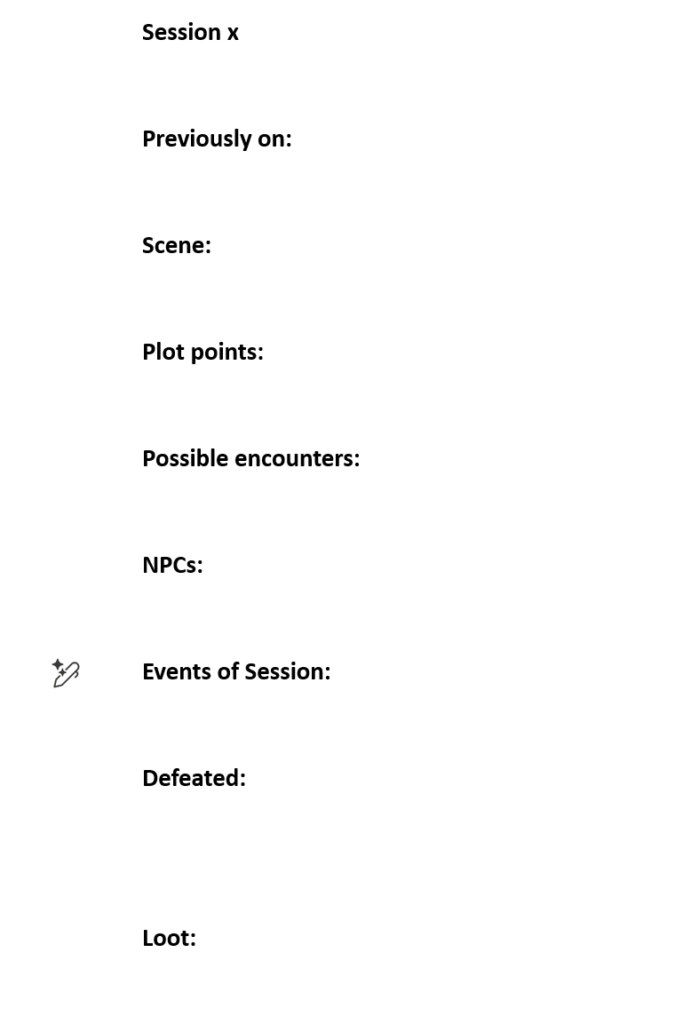
I use the layout on the right as a template. All fairly self-explanatory, but let’s think about why I use those sections.
Numbered sessions. That seems fairly basic. But I find it helps as I can remember the timelines fairly well. Having numbered, as well as named, sessions is great when I later need to find something again.
It’s nice to have two or three lines on what happened last session, then the current scene that they find themselves in. If you ask one of your players to do the game recap you can check whether their understanding aligns with your own. You can fill in any pertinent points they have missed through added hints during the new session. Why this is so great – you can guide the players without them feeling railroaded.
Follow that with the key plot points, or story beats, that need to be covered. Writing them down as simple points doesn’t take too long. Having a few possible encounters of the right level means that you have something to quickly throw in if needed. Similarly with the NPCs.
Planning Forward
The last three sections of the template are for the session itself. I jot down notes as we go along, this makes it simple to write up a “journal” that you can post afterwards for the players to read, for instance Bar Fight Report. Players often appreciate seeing the story evolve over time.
I have tasked my players with tracking their own loot, especially who has what. I used to do it myself but have decided that I have enough that I am juggling. To be honest, with two rogues in the party who are not always entirely transparent about what they find, it makes life easier. But I do still like to have listed what I have dropped.
This may seem like a lot. But with a template like this I can fill in the relevant sections in 10 minutes. And with the reassurance of the written sections to ensure nothing important is forgotten, I am then much freer to improvise the session as it develops and as the players decide to go off on a tangent.
Which leads me on to ……
Cheat Sheets
If you think that improv comedians do everything completely off the cuff then they have caught you in exactly the illusion that they want. Instead they have cues that they are ready to respond to, formulas to apply.
I will let you in on a secret. You can too. Cues and formulas to make everything seem seamless. What is the question every DM hates? The one when you casually introduce an inconsequential NPC and a player asks “What’s his name?” And your brain goes blank. But there is a simple solution. Maintain a list of names. Jot them down whenever you find one you like in a podcast, in a book, on TV (it’s actually quite fun seeing if anyone recognizes a name), or when something as simple as a road sign inspires you. Have the list open as you play. And amaze your players when you appear to flawlessly name that NPC.
Create cheat sheets. Write down some different voices – tone, timbre, pace, quirks. Now, when you need a quick NPC you have a voice to go with the name. When you have some time, then put together a few villages with the basic amenities and one note-worthy thing. Plug in one of those when the party turns right instead of left. Make a list of some interesting loot, keep a list of different species that an NPC can be, have a few taverns with their menus ready to roll out. Prepare a few random encounters for “just in case”.
Linking it Together
At least one player at your table is taking notes, and it can be really embarrassing when they recount that “Corporal Shoel de Padz” was the one in the Irilian Guard who had the sister whose husband was a werewolf when you can’t even remember which town that storyline happened in.
There are options. You can make each adventure a stand-alone, almost as though just running multiple one-shots. That works for some people, the time to play together is the most important thing.
But if you are going to have a longer story then even if almost everything you do is improvisation, you will need to understand the conections.
That is where we will come to world building in the next session and look at some of the tools available.
Freedom
Planning can lead to railroading. There are tricks to keeping the players on the route you want while not appearing to but, in the end, your crew of adventurers will have more fun when they feel that the decisions that they are making are actually having consequence and shaping what is happening around them.
Improvisation can lead to chaos. Which can be uncomfortable for everyone. If it all becomes unstructured then the narrative becomes confused. This can lead to arguments at the table, the players becoming unhappy with the DM and uncertain about what their goals are.
Following the guide above – the template, the cheat sheets, the links – then you will have the absolute freedom to run a session by responding to the players, not to being stuck on the tracks that your mind had already set in place.
By having shape from a basic skeleton then you can wander off the course because you know how to bring it back. You can improvise while being secure.
Start of a Session
Tonight’s session is a great example of how this all works.
I filled in my session template just before we began, so I knew where the PCs had come from, and the general setting. In addition, I had a basic idea of the village they were approaching, because I built it live last session when they found some villagers. Just over 200 people, a blacksmith, a church, couple of farms, and an inn. I had given those key buildings names and knew who was the village Reeve.
That’s it. That was all I needed as my jumping off point for the evening.
Introducing Flail Snails and Golden Toads
I had a basic plan, around which I was now free to see how the night evolved by responding to the players choices. Once they arrived in the village they asked for food and drink which meant we role played going to the inn, “The Golden Toad”. One of the players joked that their PC would be disappointed if there wasn’t a live toad in the inn. It’s a cute idea, and I decided to work off it. I described the bar top as having a toad carved into it, painted in gold.
Then another PCs followed up by asking the bartender why there was a toad on the bar. It jumped to mind to make a village legend of a golden toad living in a pond a mile away, but it hasn’t been seen for over 100 years. Suddenly we (I say we because the players asking questions and providing the input is as important as the DM having the idea) had something that the players wanted to explore and a story for the next session.
It didn’t stop there. On offer as food was snail casserole, a local delicacy. The PCs asked whether these are normal snails. I began describing giant sized snails near the pond. As I was doing that, I quickly checked my monster directory. Flail snails. Perfect. We now have a snail hunt.
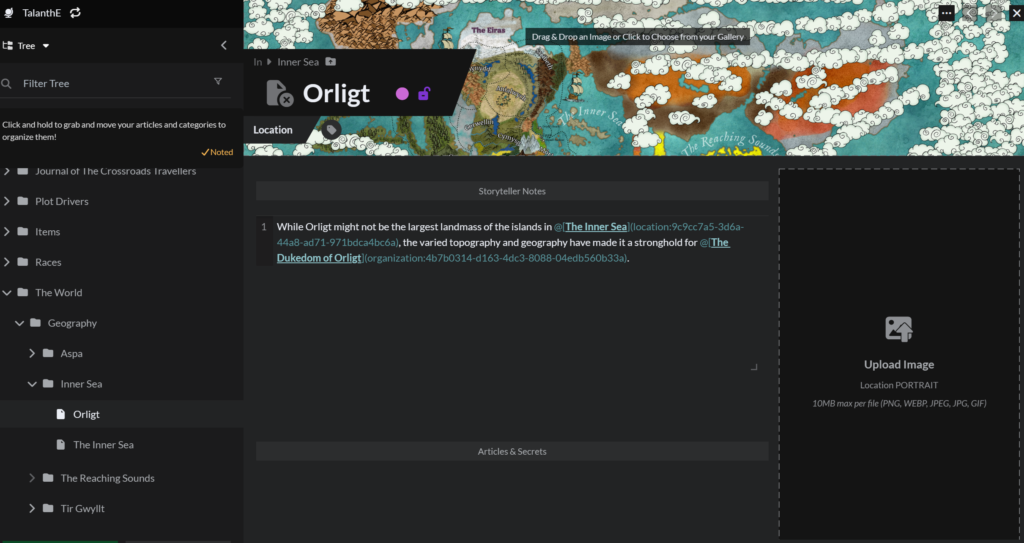
A short moment of improvisation has provided me with material for the next three sessions and also a fey protagonist for the future. In addition, by placing an encounter BEFORE the toad, I had time to make a map for that bigger encounter.
Change the Mindset
It is easy to get fooled what you see on Critical Role or other games and think “I can’t do that”. But I will let you in on a secret. They are not using improv on everything. Nor are they meticulously planning everything. Especially on YouTube, the videos you are only seeing the edited versions. Real DMs use both. The proportion depends on you and what you are comfortable with. No one else. We are all the duck on the water, paddling madly underneath while appearing serene on the surface.
Your style will change over time, partly as your game evolves, partly as life and the external demands on you will also change.
I will let you into another secret. It’s the same as I tell people just starting public speaking. The audience don’t know what you are going to say. What you think of as a mistake isn’t even noticed by those listening. When we run a game, the players don’t know what was or was not going to come up. Need to buy yourself time to think, throw in that random encounter you had in your cheat sheet earlier. Realise the players have the wrong idea, throw in a new NPC to drop a hint. They head out of the north road instead of the south which you expected, well just change where the macguffin is to be found on the map.
Don’t Stop
To return to the question at the top of this article then. Improv or prepping? I hope you see how using a combination of both feeds into the game.
Don’t let either stop you diving in and having fun.

Involved with RPGs since the 1980’s (not that I like to think about exactly how long ago that is), mainly focused on being a DM for D&D but also dabbling in other rulesets.
Run long running campaigns, one shots, convention games, and open world servers on Discord.


2 responses to “All in the mind”
This is a very important set of tools I wish another DM I know would use. As for me, I have a general idea what’s happening but a lot of smaller session are improve because of what the players decide to do.
You didn’t touch on prepping for meetings at different times. A once a month game is different than a game thats once a week.
Splendid advice! I enjoyed seeing how it all came together in your example with the Flail Snail and the Golden Toad.
Reading your article, I was able to identify two areas that I try to incorporate and where I could use some improvement. The journaling or written history of previous games is so important, especially as I get older and can’t remember as much. What I am trying to work on… is jotting down the important details after the game, when they are still fresh in the mind. But, being a procrastinator, I usually wait until the night before or morning-of a game. Some of my games are 4 weeks apart, making my recollection a bit iffy, lol.
But, what I use the journaling and session recap for, and why I choose to still do it rather than have the players, is to reinforce plot points or interactions that the players may not have picked up on.
Wrapping up, that last secret is gold. A lot of anxiety and worry can subside by realizing that the players, 9-times-out-of-10, are not going to know if you made a mistake in a game.
Digging your articles, keep up the great work!