Last month I presented an article attempting to persuade Dungeon/Game Masters to expand their Inspiration rewards systems to include positive behavior which supported the game while occurring outside of it. Voluntary Player Roles (VPRs from this point forward) represent valuable aspects of play normally defaulted to the DM but available to be parsed to the players instead. I’d like to take the opportunity to discuss in detail the reasons that VPRs are a valuable tool, particularly when paired with an Inspiration system with a higher max cap, such as the one presented here: https://wallydm.com/the-rule-of-three-tripling-the-value-of-inspiration/ . Finally I will present some sample VPRs which have been assigned names/titles for clarity.
(An added note: these roles are written primarily for live play – many role responsibilities may be covered by VTT features and macros. That said I do believe that adjusted VPRs can still add group cohesiveness and added value to your online games with a little tweaking. Thank you Vazin for pointing this out.)
For a list of lesser but in-character responsibilities as well as viable alternate naming options, check out the jobs (Mandatory Character Roles) described in 5e’s Acquisitions Incorporated source-book.

Okay, but why though?
There are many reasons why adding VPRs will increase the overall enjoyment of your table, but for brevity I will illuminate only four:
-First, a DM that can rely on others at the table to handle excess tasks is able to better focus on their core responsibilities.
-Second, people consistently place greater value in experiences they are personally involved in creating: there’s a deeper psychological connection to the outcome, and we tend to assign more worth when we are involved in order to validate our own contributions.
-Next, specific, defined, personal responsibilities nullify the Bystander Effect on which person should act in situations that would otherwise be nebulous such as who should be taking notes on the exposition dump or which poor soul is actually carrying the cursed sword from the green dragon’s hoard.
-Finally, a more balanced workload reduces stress and subsequent DM burnout: someone contributing 95% of the effort in a campaign is more likely to be overwhelmed than someone in the same situation who only has to do 60% instead. The candle that burns at both ends only burns half as long.
VPRs
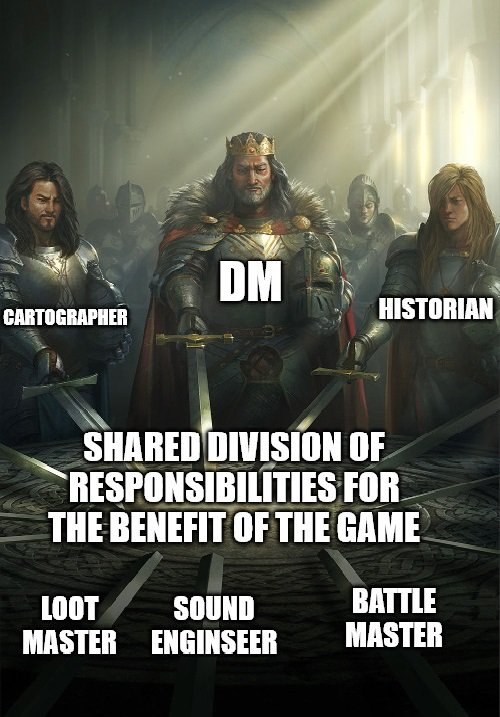
Though each of these roles adds value to the game, some are certainly more critical than others. I will list those which I feel are primary responsibilities first, those with the greatest benefit to the table to fill. Some, such as the Cartographer, are campaign-style-specific . If you have more players than roles that need filling consider splitting a job further: a Loot Master’s domain could be divided between a Master of Coin (art, gems, currency) and an Attunementor (scrolls, potions, magic items). Finally, before we get to the list you should consider that these require two-way trust to actualize; you must trust that your players will fulfill their roles as needed while they trust you to help them by giving needed information and instruction for them to succeed. When someone volunteers for a role that means that your responsibility is lessened, but never eliminated. Check in as needed, pay your volunteers with automatic Inspiration, and work with your players to rename the roles to fit your table.
Primary VPRs:
Cartographer – Exploration/Dungeon-focused only: This player creates and maintains layout maps of dungeon interiors as well as those of any world map-exploration. This may further include the drawing out and/or revealing of character-scale dungeon tabletop maps, depending on your game style.
Historian – Documents the names of important people, places, and things. Maintains and organizes group notes on connections, reputation changes, world events, and party quest progress. Provides session summaries when needed.
Timekeeper – Coordinates available days and times for upcoming sessions. Locks in schedules well ahead to minimize last-minute planning and ruined dates. Contacts other players regarding changes and proposes viable alternatives. Gives the DM a head’s up when the scheduled session end time is approaching. Keeps track of the current season, day, and/or rough time in-game if that kind of thing is needed. Finally they may also keep tabs on Initiative order in combat in no other player claims the Battle Master VPR below.
Loot Master – Catalogs all valuables and physical items gained by the party. This person’s character is not expected to carry all of a party’s wealth, but instead to keep track of how much each receives from gathered treasure and the like. Furthermore, this person keeps track of which items require attunement and who is carrying the item in question. If your group tracks encumbrance than this role will also calculate weight. When one-use items such as scrolls or potions are consumed the Loot Master marks the item from the party’s list.

Secondary VPRs:
Battle Master – Assists the DM to maintain the flow of battle. Uses sources to confirm attack ranges, modifiers, damage, etc. If available this player may also hand out appropriate spell reference cards or condition effect rings, removing them when they no longer apply. If necessary this role can also handle Initiative turn reminders. Requires intermediate game knowledge.

Sound Enginseer: Uses technology to properly set the background’s mood and tone of the gaming space. Background music – unobtrusive accompaniment that matches the wanted intensity of a scene. Environmental Layer – Distant thunder, murmuring crowds, crashing waves, birdsong; these are all examples of environmental textures that keep players in character. I have found cheap white noise machines invaluable to this end – many have thirty or more different settings to pick from. Requires extra technology, apps, and/or access to the host’s virtual voice assistant such as Alexa or Siri.

In Summary
After discussing the change during our Session 0 I have found a significant improvement in my games since we’ve added Voluntary Player Roles – my own ratio of time spent preparing for a game has changed from 4 hours of prep : 1 hour of play to only 2:1. My own stress is down during live play while my players seem more involved and attentive. VPRs have really cemented the modern positive team aspect of the game; I am not running a game for them – we are all playing a game together.
I hope that the same works for you. Best of luck.
Thorn

Forever DM
Cat Dad
Head of the Deathskull Boyz gaming club
Amateur game designer
Alliance guild leader of the Scarlet Brotherhood, Warmane – Icecrown server, WoW



2 responses to “Share the Load: Voluntary Player Roles”
Offloading some things to players do help a lot. My current player keeps track of a lot of things too which allows me to focus more on the story.
People don’t realize the Dm needs time to Think inbetween things.
Can confirm. Having a player keep track of story developments not only helps the DM, it shows what the players care about and remember. Love having roles at the table. I tend to see them more mandatory than voluntary. 😀 Everyone should contribute.