
As I start this article I very much want to stress that, as a DM, you don’t have to do voices. Don’t let voices be the reason you don’t start running a game. And bear in mind that most of the podcasts you are listening to have professional voice actors (as an example, listen to Malevolent, amazingly all the voices are by one person, Harlan Guthrie). Do not try to measure yourself against them.
That said – it can be fun, for you and your players.
So how do you go about having multiple voices for your NPCs.
The easiest approach is think about the complexity of voices as layers. The more layers you add then the more variety you will have but even one layer makes it easy to respond off the cuff.
Quick and Almost Painless
The quick way is to have various catch phrases for accents. For Welsh then I quickly repeat “Ivor the Engine” a couple of times. By the way, if you are either not British or are too young, take five minutes out of your life to give yourself a smile by watching here. But getting back to accents, for Cockney try “you’re only supposed to blow the bloody doors off”. My Scottish accent comes from “there can be only one”, Aussie “g’day cobber, she’ll be right in the arvo”, and Southern “well, I just have to say”.
Learn a couple of phrases, then you will be quickly grounded in the accent and can get going.
When you add in a couple of slang terms – easy enough to find – you are ready to go.
Even doing this, your three guards on the gate can each be distinct. But what about characters that are going to appear throughout your campaign.
Begin to Add Depth
Depth means starting to get actually in to the character. Yes, this is beginning to sound a bit like acting. No, it’s not that scary.
Think about your NPC. What kind of person are they? Nervous, energetic, laid back, thoughtful? If playing an elf, imagine tree tops and summer days. Need a dwarf, think of deep mines and claustrophobic spaces.
Sit in your chair, or stand, as you imagine that person would. Are you on the edge of your seat, sprawled backward, or bolt upright. Take that same position every time you are that NPC. And your voice will naturally change. Posture has a massive impact on your voice.
A Bit Of A Tick
Next layer. We still don’t need to get to the real depth yet. Right now we just want to think about how to give our NPC some individuality.
Another nod to British readers of a certain age, you may know of “The Vicar of Dibley”. A character in that series, Jim Trott, was renowned for “no, no, no, no, yes …….” I have a NPC that has that tick, and he appears in multiple campaigns. The tick makes him stand out.
Give the PC a tick. A deep breath at the beginning of each sentence. A sniff. A stammer. Monotone.
Engage More Complexity
This is where we start to understand what makes up a voice – timbre, pitch, intensity.
- Pitch (higher or lower than your normal voice)
- Pace (faster or slower speech)
- Weight (heavy/forceful vs. light/airy delivery)
Pitch is how high or low your voice is and pace how quickly you speak. Weight is a little more complicated in that it is partly dictated by where your voice comes from, is it coming from the top of your head which makes that sinus drone, or is it going to come from down near the diaphragm which makes it a richer sound.
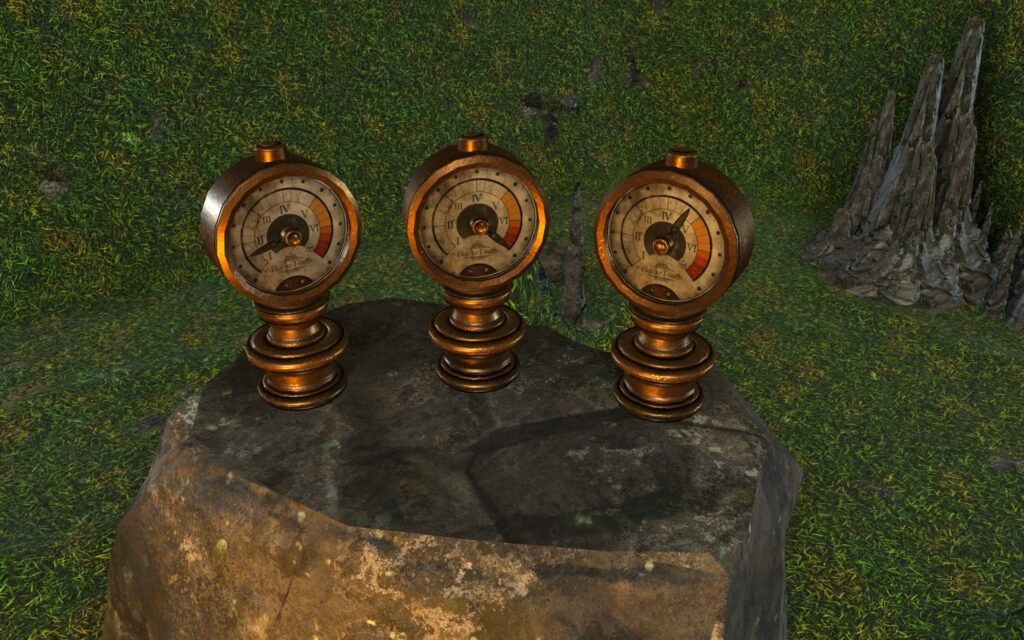
Playing around with these brings about different voices. Imagine that those characteristics are each on a dial numbered one to ten. Alter two of those dials and the voice will sound different.
Why and When
Let’s be clear. Accents can be fun, yes, but they can require the players to focus on your voice, not what is happening. Think about when you use your voices.
If your PCs are going into combat then it may not be appropriate to overlay too many voices. Your players need to be thinking about their tactics, what attacks or spells are they going to use. This is not the time to be the distraction in the game
However, need to lighten the mood around the table, a bit of comedy will help, and that can be easily added with a jovial NPC and the voice to match.
Want the group to try diplomacy rather than going murder hobo, add some gravitas to who they are talking to. If the NPC seems different to what the party normally meet then the players are guided to handle the character differently.
Use voices when you want the players to remember a character.
Tips
- Develop Catchphrases: Use repeated phrases to anchor the accent. Pick a character from a series or film, and use them to summon the voice.
- Practice Between Sessions: Short, regular exercises retain accent familiarity. That’s what dog walks are for. OK, the neighbours might look at you as though you are crazy.
- Create Memory Triggers: Associate voices with specific character traits. When you imagine those traits then it will put you into the right place.
- Visualize the character: Picturing them helps understand what they will sound like.
- Keep track: Write down aspects of the voice in your character notes so you can recall it next week. Or next month. Much easier if your notes read “Talynne Pitch 6 Pace 4 Weight 8”
Finally
Remember that there is no pressure on you. Take it easy and at your own pace. Beginning to feel overwhelmed, then stop for a while. Pat yourself on the back for what you have done.
When I manage to deliver a voice for my characters then I get a real buzz. And players notice. It is worth the effort. It is easy to feel silly, self-conscious. But I promise you don’t need to. Be willing to try, be willing to fail, be willing to learn. Your group will admire you for trying.
And just to prove that you have to simply get in there, no point in being embarrassed, I have put together a quick audio file, this is a simple one-take, no editing, no script:

Involved with RPGs since the 1980’s (not that I like to think about exactly how long ago that is), mainly focused on being a DM for D&D but also dabbling in other rulesets.
Run long running campaigns, one shots, convention games, and open world servers on Discord.



3 responses to “Voices In My Head”
I almost missed the audio file! That was an exceptional include, thank you for doing that. Was great to hear the advice put into action. Oh, and now I know who Ivor the Engine is… that was a neat-o inclusion as well.
I hafta admit, I always gobble up ideas on how to better use voices and accents. They are usually something I’m not good at but enjoy doing anyway.
My main go-to now-a-days is changing pitch and pace. The catch phrases idea has been one I’ve been using for a while, and I use them frequently for impersonating the speech/accents of Sean Connery, Adam Sandler, and the voice of Deckard Cain. Also a couple of my own for Southern and Irish.
I hadn’t tried the posture idea, but ya know, it makes sense! I’ll be incorporating that in the future.
Well done, once again! On to the next!
One thing to remember is not to fall in to sterotypes. That’s a very bad habit that can happen if you’re not careful.
I never do voices because I get toung tied very easily. I do subconsciously vary my voice slightly sometimes, but the most important is to get the vocal tone right. Knowing when to pause or draw attention to certain words, stressing the right constanants and such.
In person you can portray body language easier but if it’s voice only, thats very hard to do.
Good point and that is why I included the why. It is not always appropriate. Don’t distract from what is important.